Clowns in Bernard Buffet’s Work
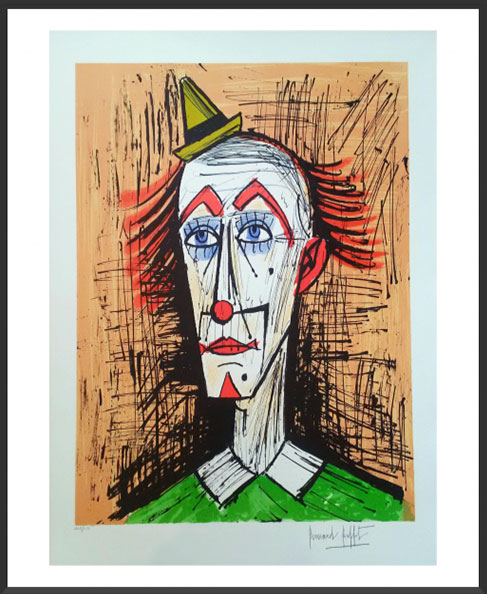
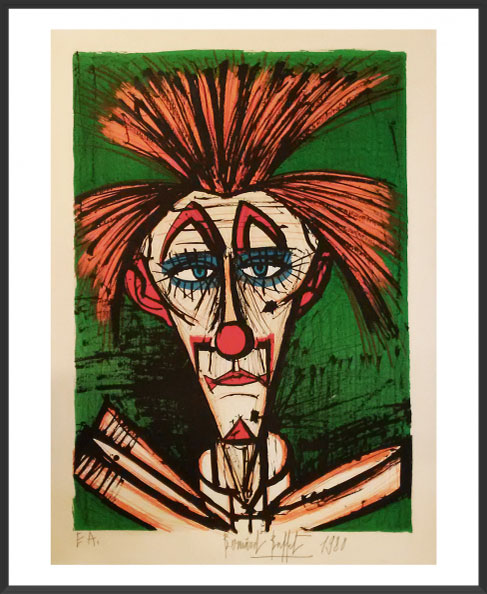
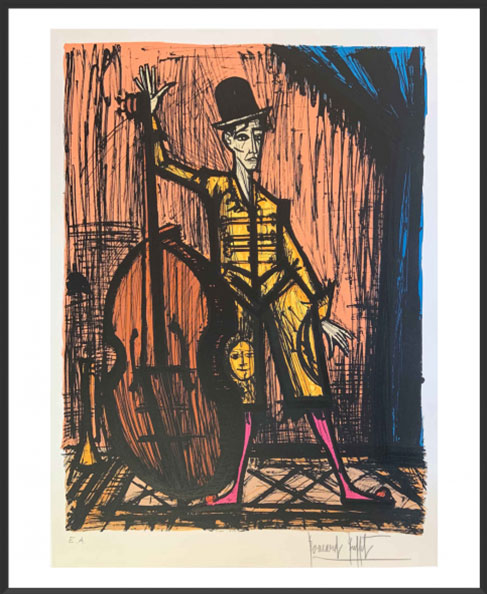
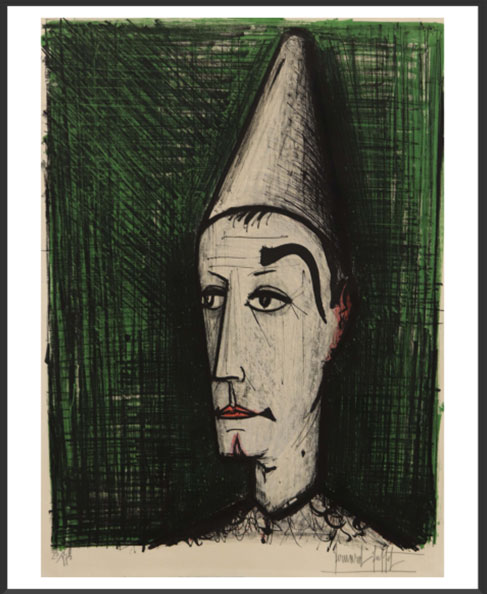
Among his most emblematic themes, the circus occupies a central place. The clowns, which became a hallmark of his style, are among his most famous and recognisable works.
Through these figures, he developed a sombre and lucid vision of humanity, rooted in the post-war context.
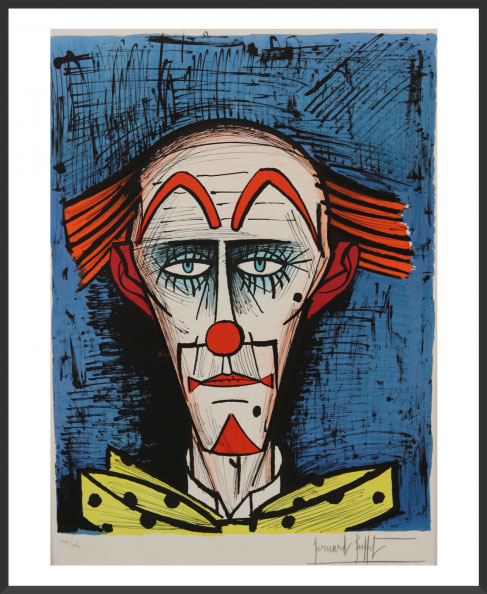
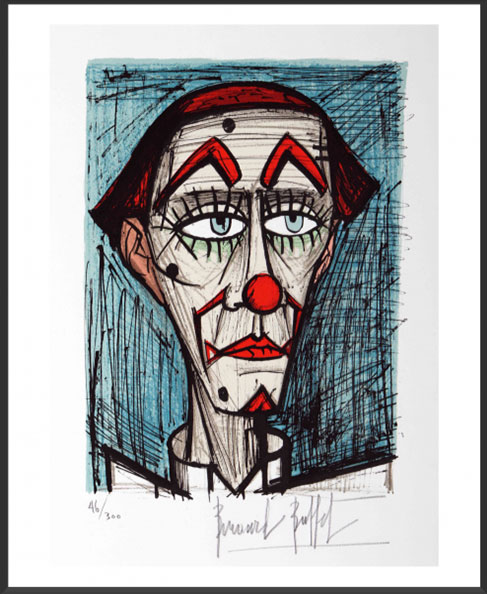
Why Did Bernard Buffet Paint Clowns?
The popularity of his clowns stems largely from his ability to capture the mood of post-war French society. His dry, sharp black lines seem shaped by years of suffering and deprivation.
His clowns express the existential anxiety that accompanied him until his suicide in 1999.
Buffet viewed humanity as “insignificant” and “ugly.” The clown reveals, dramatises and magnifies a humanity masked both outwardly and inwardly. Through the circus, he stages the theatre of the world.
The Clown as Symbolic Self-Portrait
Many of his clown portraits can be interpreted as disguised self-portraits.
He projected into these figures his anxieties, contradictions and inner tension. Sad clowns, with elongated faces and fixed gazes, convey profound solitude.
Harlequin appears in multiple forms, oscillating between shadow and light, irony and gravity. This ambivalence reinforces the introspective dimension of the series.
The Style of Bernard Buffet’s Clowns
His clowns are characterised by:
- strong black lines
- elongated faces
- rigorous contours
- a palette often dominated by cool or muted tones
- a solemn or melancholic expression
This stylistic treatment is characteristic of his entire body of work and gives the clowns an immediately recognisable dramatic intensity.
Clowns and Bernard Buffet’s International Reputation
The clown series significantly contributed to Bernard Buffet’s international recognition.
These works remain among the most sought-after by collectors and represent one of the strongest symbols of his artistic universe.
The Blue Clown (1955)
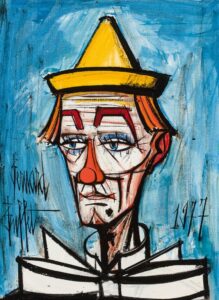
The Blue Clown, painted in 1955, is one of Bernard Buffet’s most famous works.
Frequently reproduced, the original painting belongs to the Bernard Buffet Foundation. Any other version is necessarily a reproduction.
This work perfectly illustrates the tension between colour and graphic rigour characteristic of this period.