Bullfighting and Toreros in Bernard Buffet’s Work
Bullfighting was one of Bernard Buffet’s preferred subjects. Like Pablo Picasso and Francisco de Goya before him, he found in tauromachy a theme that is dramatic, ritualistic and profoundly aesthetic.
His fascination with bullfighting inspired a significant series of paintings devoted to toreros and arena scenes.
Why Did Bernard Buffet Turn to Bullfighting?
Bullfighting offered Bernard Buffet a concentration of tension, staging and confrontation.
He attended bullfights, notably in Arles and Nîmes, and was captivated by the ceremony: the entrance into the arena, the paseo, the torero’s posture and the silent anticipation of the audience.
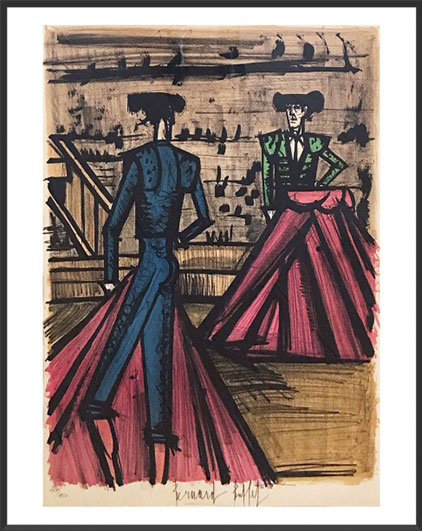
From the Biennale de la Jeune Peinture onward, he presented works depicting the paseo and toreros surrounded by their cuadrillas.
In tauromachy, he rediscovered themes that run throughout his oeuvre:
- solitude in the face of destiny
- the imminent presence of death
- dramatic tension
- the theatrical dimension of gesture
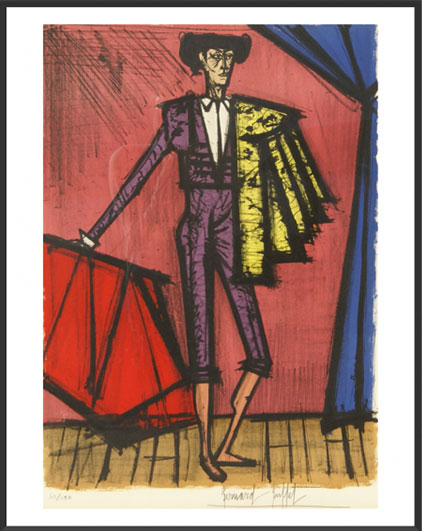
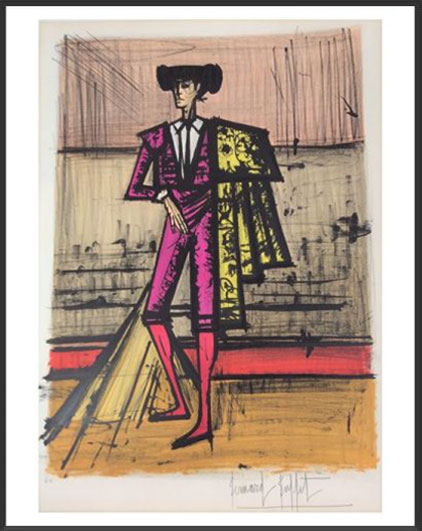
Portraits of Toreros
Bernard Buffet created numerous portraits of toreros, many of which now belong to private collections.
The toreros are depicted standing, hieratic, dressed in traje de luces. Lines are taut, faces elongated and gazes fixed. The torero becomes an almost sculptural figure.
These portraits condense the defining characteristics of his style:
- bold black line
- rigorous construction
- asserted verticality
- psychological intensity
Annabel Buffet and Tauromachy
Bernard Buffet introduced Annabel Buffet to bullfighting. She herself spoke of her emotional response to this art form, which she described as exceptional.
In 1963, at Château l’Arc, Annabel posed in traje de luces for her husband. This staging blurred the boundaries between model, muse and character.
Through this series, Bernard Buffet transformed bullfighting into an intimate theatre where love, tension and awareness of danger intersect.
Bullfighting as a Concentration of Bernard Buffet’s Talent
The paintings devoted to toreros demonstrate Bernard Buffet’s remarkable visual memory. He could depict a figure after observing it only once.
Each torero becomes under his brush a singular figure, both elegant and tragic. The flamboyant costume contrasts with the gravity of the face.
Bullfighting thus appears as a metaphor: a ritual combining bravery, staging and confrontation with death. This tragic dimension echoes the other major themes of his work.
Bullfighting Within the Broader Oeuvre
Bernard Buffet did not treat bullfighting as an isolated episode. He painted tauromachy scenes alongside other series, including Provence landscapes and Venetian views.
The theme of toreros forms part of a broader serial approach characteristic of his method: exploring a subject exhaustively through its many variations.